Take Care When Riding Upright on the Trainer

Bike Side by Side Pics.png

Who’s guilty of warming up on the bike trainer or stationary bike sitting upright, hands free, scrolling through social media?  Me!  Riding upright in the saddle with unintended excessive lordosis (arch) in the lower back could cause back pain and injury (see photos above). 

Mike Irwin, owner of BicycleFit Rx recently weighed in on this subject: "For triathletes, the nose of the saddle is purposefully adjusted in more of a downward tilt for proper fit, so sitting upright will tend to cause even more anterior pelvic tilt.  Once the athlete starts pedaling in the upright position and the hips are moving, it forces the back into more extension (tilt)." 

So, friends, be aware of proper posture when riding upright and use a strong core to stabilize and prevent back injury.  Otherwise set that phone down and lean forward, hands or forearms on the bars!  

Follow us on Facebook For More Training Tips & Fitness Education

Article Co-contributor:  Mike Irwin

Coach Amy Across the Globe

Michael+Germany+Running-+Flag+Center.jpg

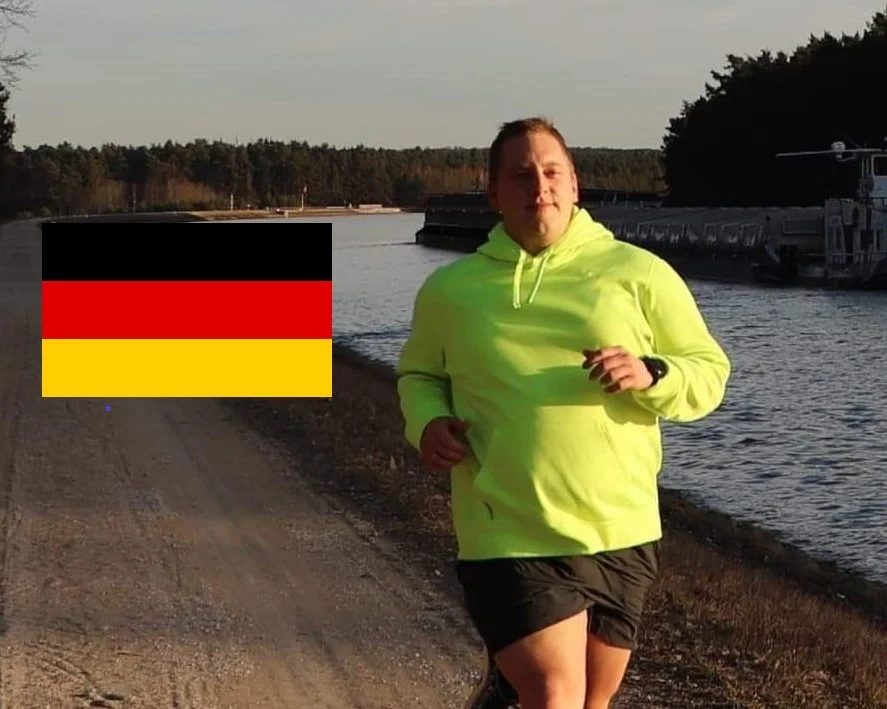
I was pleased as punch to get a message from Michael in Germany telling me about his 5K training, “I’m now in the third week of your training plan and getting better and feel a bit stronger.  I just wanna say thanks, and I’ll keep going forward to reach my personal goals.”  

Hearing athlete’s stories about their training and race adventures is one of my favorite parts of coaching.  I was thrilled to learn that not only is Michael finding my training program helpful, but due to Garmin Coach's incredible reach I can help someone I've never even met and who lives so far away.  

“Congratulations, Michael, on reaching your third week of training!  I'm so pleased to hear that you're getting better and feeling stronger.  I know you can reach those goals.  Please keep me posted on your progress!”

It puts me over the moon with joy to hear how all of my Garmin Coach, CoachAmyPT patients, and Roadrunners of Kansas City athletes are doing.  Receiving updates not only helps keep me in the loop, it also creates a community of people when we share your stories in an effort to inspire and motivate each other.  Thank you, Michael, for reminding me how big of an impact a simple message can have. 

Share your update by Posting a Review on our Facebook Page, or email Coach Amy by clicking the envelope icon below (info@roadrunnerskc.com). Keep 'em coming, people!

Post a Review on Facebook
Information on Garmin Coaching

Don't Run on a Balance Beam

Cross%2BOver%2BMuddy%2BBloody%2BAnkle.jpg

Ever have muddy, bruised or bloody shins or ankles after a run? This can happen with a crossover running gait. Not only does it leave unwanted scuffs on your ankle, it is inefficient and can cause IT band pain, knee pain or shin splints. 

Most runners don’t even realize they have faulty gait patterns. In this article from the CoachAmyPT blog Coach Amy explains (and demonstrates) what the crossover gait looks like, and why runners lose power and increase their chances of injury with this run gait.

Article Here

Like us on Facebook and Instagram for more training tips and trends.

Get More From a Strong Core

Phoenix%2BRising.jpg

In today’s fitness focused world, we’ve all heard a lot of buzz around “strengthening the core.”  Wondering what all of the hype is about?  Focusing on improving core strength on cross training days can improve athletic performance and prevent injury during training.

With a strong core our movements are more efficient, and we gain more power and function from the upper and lower extremities.  With a weak core, we are like a “rag doll”; our arms and legs move less efficiently, and energy is wasted. For endurance athletes, a strong core translates to more power in the arm and leg swing while running, the pull and kick while swimming, and the push and pull while cycling. 

Contrary to popular belief, having a strong core doesn’t just mean having strong abs.  Our core encompasses the entire cylindrical column of muscles ranging from above our shoulders to below our hips.  Athletes have to be very strategic about how they engage these muscles and make them stronger.

CoachAmyPT offers core strengthening classes designed for both beginners and advanced athletes. Phoenix Core classes focus on slow, controlled, quality movement patterns.  While Phoenix Rising classes incorporate higher intensity moves to train runners to be more explosive and push off the ground with more power. 

Choose the class that’s right for you, and join us for the first Spring session beginning the week of March 4th.  Hurry, space is limited.

SIgn up for Phoenix Core
Sign up for Phoenix Rising

Like us on Facebook and Instagram for more training tips and trends.

To Treadmill or Not to Treadmill?

Ice, deep snow and sub zero temperatures are driving many endurance athletes indoors to the treadmill this winter. Unfortunately, running a long distance on the treadmill may do more harm than good especially if used as a short term substitute to overground running without adjusting for the fact that it is a different surface. In this article, Coach Amy explains why runners should exercise caution when choosing the treadmill and shares tips on how to treadmill safely.

IMG_5333.jpg

The way our joints and muscles respond to running is different on different surfaces such as grass, mud, rock, sand or rubber track. There is not yet a consensus among researchers as to the differences between overground running v.s. treadmill running, however many sound studies show a significant difference in the forces or load on certain muscles and joints when comparing the two surfaces. Riley, P. “A Kinematics and Kinetic Comparison of Overground and Treadmill Running.” Medicine and Science in Sports and Exercise. 2008.

Because of these differences, runners could sustain injury if they try to run too long or far on a surface that is new to them. I see injuries in the clinic every winter when non-treadmill runners jump on a treadmill to “get in a long run.”

So what is an endurance athlete in the winter supposed to do when a 20-mile long run is on the training schedule but it’s icy and -10 degrees outside? I recommend splitting up the mileage (or time) amongst several different options. For example, alternate running 30 min on the treadmill, 30 min. on an indoor track and 30 min of elliptical. Repeat if necessary. This will break up the monotony and give the chance for muscles to adapt and recover from the varying loads/stresses of the different surfaces.

To prevent injury from running on a treadmill follow these tips from Coach Amy:

  • Keep at least 1-2% incline to account for lack of wind

  • Vary the incline throughout the run to spread out the load to a variety of muscles as you would with the natural grade of a road run.

  • Start with a short distance/time e.g. (20-30 min)

  • Vary the speed of the belt throughout the run rather than staying at the same speed (helps prevent changes to gait with fatigue)

  • Make sure the belt is in good working order (stiff, not loose)

Subscribe to the RRKC Blog for more running tips

Schedule Physical Therapy
Hire Coach Amy

Need for Speed

speed work.JPG

Improve race pace, feel stronger crossing the finish line, and prevent injury with your run buddies! RRKC’s 6-week Winter speed work session starts on February, 12th.  Sessions are held at various outdoor parks on Tuesday evenings at 6:00 p.m.  New location this round at the paved trails at Somerset and Nall! Space is limited, so act fast to run fast!

Sign up for Speed Work